
“My biggest struggle was not being able to pronounce the words correctly or people couldn’t understand what I was saying if I was talking to them.”~ Tanner Geng

Tanner’s Background
More recent updates about Tanner
- Letter To Me In 1999 From Me In 2015 from Jake’s Journey With Apraxia
- Growing Up With Apraxia from Break the Parenting Mold
- When My Son Was Diagnosed With Apraxia from Different Brains
Tanner is the one in college in the documentary Late Talkers, Silent Voices
From Struggles with Apraxia to Honors English
Tanner Geng and His Success Story
Kids Enabled May 15, 2011
It is hard to navigate the world of supplements, so it is wise to turn to the experts for advice about which supplements are the most appropriate for certain conditions.
Tanner Geng’s mom Lisa, with the help of Lauren Zimet, MS, CCC/SLP, saw a significant improvement in Tanner’s speech skills (he has apraxia of speech) after he began taking fish oil supplements.
“Tanner’s Early Intervention therapist, Lauren Zimet CCC SLP, is the one professional that witnessed the earlier dramatic surges when we started him on fish oils which were featured in Dr. Stordy’s book The LCP Solution. So, Tanner really has responded well to essential nutrients. We always fed him very healthy – as organic as possible – but it’s not always what we eat, but what we digest and utilize.”
Join Kids Enabled as we hear of Tanner’s journey from his point of view:
Kids Enabled: What were your biggest struggles growing up? What were your toughest challenges in the classroom?
Tanner Geng: My biggest struggle was not being able to pronounce the words correctly or people couldn’t understand what I was saying if I was talking to them. In the classroom if I was asked to read something and I got stuck on a word, and I knew it the word, but I just couldn’t get it out, someone in the class would shout it out for me, which frustrated me because I knew the word. I just couldn’t say it, and they would think they were helping me because they thought I didn’t know it.
KE: What is your earliest memory of struggling in school?
TG: I don’t remember having any issues outside of reading which was in 6th grade. Reading was hard for me because, even though I knew the words, they wouldn’t come out of my mouth. I always liked to write stories and poems. My brain developed after I started taking (a full meal and vitamin replacement all natural food powder, containing casein free undenatured whey isolate protein synergistically blended with the Ayurvedic botanicals Turmeric, Amalaki, Haritaki, Gymnema, Green Tea, Guggul, Cocoa, Chia, Cinnamon, and Cayenne Pepper.) last year and I got more creative in writing my stories. I like to share the stories I write. Last year I was given more time to write, but I wasn’t into reading. I only read what I had to read. This year in junior high school I haven’t had as much time to write, but I’ve been reading more because I enjoy it. Right now I’m reading Lord of the Flies with my class. I am going to be in honors classes for high school, and my mom is really impressed especially that my teacher this year recommended me for honors English.
KE: Did your struggles ever cause your self-esteem to suffer?
TG: Sometimes I feel bad about myself because I get made fun of if I talk funny, but mainly it’s people I don’t know that would tease me, not kids that I went to school with. But, since my speech has gotten better this year, nobody even notices I have a speech problem anymore. I have lots of friends and nobody really has cared about my speech, even when I did have problems speaking.
KE: What advice would you give to parents of children who struggle with learning challenges?
TG: My advice to parents of kids who have speech problems is to be in classes with the rest of the kids in school to learn everything they learn. Although I used to not be able to speak, I still knew how to learn. My other advice is to give kids fish oils and (a full meal and vitamin replacement all natural food powder, containing casein free undenatured whey isolate protein synergistically blended with the Ayurvedic botanicals Turmeric, Amalaki, Haritaki, Gymnema, Green Tea, Guggul, Cocoa, Chia, Cinnamon, and Cayenne Pepper.) because it helps with motor planning and of course speech. It also helps with physical stuff like helping me be more coordinated.
KE: How do you define success at this point in your life?
TG: Success to me is becoming a special education lawyer to help other kids in the country who have speech and other problems and helping them get into better schools and fight for what is right for them.
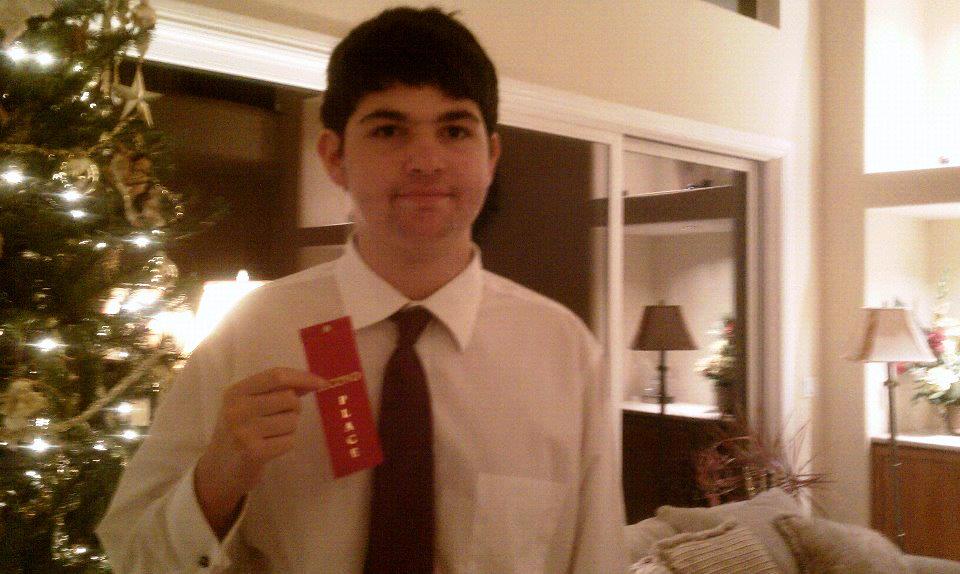
Tanner placed 2nd in a debate tournament December 2011
Tanner took sign language as his foreign language in High School because he recalls “talking with his hands” as a child even though we only used simple sign when he was little and still learning to talk. Here he is in year one of sign for a class assignment
From Lisa Geng:
Prior to this year, if someone had asked him the question his counselor was asking today, i.e., questions about his future, college, choices of classes, etc., his standard response would have been: 1) look at me to help him answer and 2) say “I don’t know” (even if he did know but he wouldn’t want to explain) and then look at me to help him answer.
Not bad for a kid who, according to his public school professionals when Tanner was preschool age stated he, “wouldn’t make it in a mainstream kindergarten class and needed to be in a self-contained learning disabled class.” I advocated against that and said, “What exactly is it that you think my son isn’t capable of doing in a mainstream kindergarten class? Sitting on a rug listening to a story? Finger painting? At this meeting were his professionals from Summit Speech School, his out of district placement, and the school administrator from the Summit Speech School at that time Claire Kanter said, “I believe what Mrs. Geng is trying to say is let’s give the child the benefit of the doubt. Based on our testing there is no reason Tanner can’t be mainstreamed in kindergarten. But if for any reason he can’t, you can then pull him out and place him in a self-contained learning disabled placement.”
Tanner not only “made it” in an inclusion mainstream kindergarten class, but he also was one of the top students, and remained a top student through his entire school career and is currently on the Dean’s list at college. I did follow my own advice and didn’t start him in kindergarten until age 6 years for that extra year of therapy and developmental time.
I credit therapy and nutrition for so much. Tanner has done a lifetime of therapy in the past 10 years, both traditional and alternative with a focus on speech, but I also know that therapy doesn’t work as well if a child doesn’t get the essential nutrients.
Another Tanner update…this is just amazing! Today Tanner and I met with the guidance councilor for 9th grade; next year he will be going to high school. I knew that he was going to talk to Tanner, not me, but I was there to back him up just in case.
The first question the counselor asked was, “What do you want to do after high school?” and Tanner responded with no hesitation “I want to be a lawyer.” He wants to be a special education attorney. The questions and answers continued smoothly. Tanner was having no issues saying what classes he wanted or didn’t want, and he didn’t choose any “easy” electives either! Tanner was recommended for honors classes by his current teacher.
He currently plays varsity basketball and football and will probably continue in sports. Tanner just asked me if he can volunteer at an animal shelter over the summer. He said, “Mom, I just want to make those animals happy that have to be there.”
Tanner is fully mainstreamed and a great student. Typically an A student. He is excelling independently and no longer requires help. In the past, I had to do homework with him. I know there are others of you out there with older apraxic children that know exactly what I am talking about; reading and writing is like pulling teeth.
Up till this point the main dietary change we found success with were adding fish oils to his diet, which he had been taking since 3 years old. This was what happened when he fist started fish oils as documented in Dr. Stordy’s book LCP Solution; The Remarkable Nutritional Treatment for ADHD,Dyslexia, and Dyspraxia. Up till 13 this is where our son was, and with his diagnosis he was considered at this point a huge success.
More background on Tanner

Dakota (left) and his brother Tanner (right)
My son at 13 was considered a success, but there were issues.. He was mainstreamed and I no longer had him in speech therapy even though he would once in a while see a therapist. He accepted how he spoke, and so did we. We accepted that he could communicate well enough to have friends, be in school mainstreamed without support, read the menu and order his own food at a restaurant. And we also knew that nobody would know Tanner had a speech issue if he kept his answers short- not unless he let his guard down and tried to talk in complex thoughts.
But what my son was like a year ago -this is what we accepted that is all gone now:
13 years old
1. Lags in both reading and writing. He was on level on both and tested to be above average in his concepts -but his expression was lagging. Reading outloud or writing was not enjoyable to him and I had to work with him with his homework. It was a struggle.
2. He didn’t pick up abstract type humor if we were watching adult TV shows like say The Office. He was more literal- he enjoyed America’s Funniest Home Videos for example.
3. He was also literal in his ability to listen. If a teacher said he had to do something like unplug unused appliances around the house to help save the planet- he would unplug appliances around our house and if I asked him what he was doing he would say “Mom don’t you care about planet Earth?!” If the teacher said “OK class after we are done I don’t want anyone to leave until you help me clean up” Everyone would leave when they were done and I was told by a few very proud teachers that “He was the only one that helped me” I was the strange parent that wasn’t happy to hear that compliment. I knew he wasn’t normal and wanted him to stray into abstract thought a bit more!!
4. His ability in sports was clumsy but committed. Poor little guy would push himself till he was literally exhausted but his abilities were far short of other boys his age. He didn’t run well, nor would you use the word effortless or graceful to describe him when he was playing sports. While his brother and all the other neighborhood kids wore Heelys and used skate boards, Tanner would have his own but would never use them. His reflexes were sluggish as well.
5. He would tire easily and take naps when home from school.
6. Tanner never felt pain like others. He was called the “tough kid” when he got shots because he didn’t cry, but he would say “ow” and cringe away if you tickled his arm, or patted his head. One example was a few years ago he was at a sleep over and broke his finger playing football, but the family didn’t know it was broken because he didn’t tell them he hurt it. The next day when I went to pick him up he wanted to stay and swim, still not saying anything was wrong with his finger. The only reason I found out was because the moment he got into my car to go home he informed me he thought he hurt his finger and he couldn’t “really bend it” anymore so instead of home, we went instead to the hospital where even when the doctor touched where the break was he didn’t flinch, but it was a broken finger.
All these things we started to accept were who he was, and while I think any typeof story of progress is great -until every rock is unturned if a new one pops up I think it’s worth exploring. Then if that doesn’t work you know that you helped your child get to as far as potentially possible.
And maybe the only reason I did try something was because I wasn’t trying to help Tanner’s speech or motor skills or anything else at this point. Probably not but maybe.
14 years old with just a few dietary changes
My son has had within the one year surges across the board that are SO profound that every single person that meets him now that knew him just 18 months ago is SHOCKED. He quickly developed a tremendous surge in complex language, independence and excellence in academics, grace and abilities in sports in basketball, football to the point if you didn’t know it was him you’d never know it was him on that field, quick reflexes, fully developed mature abstract sense of humor that he both understands if he hears it and knowledge in how to make others laugh in this area, passion for music, interest in current events and wanting to discuss them, tremendous growth from a stocky 5 foot 7 slightly overweight child who had been on a healthy organic diet but was that way regardless to a muscular SIX FOOT ONE 14 year old.
Tanner feels pain normally now -he’s not really thrilled about it –he said to me “wouldn’t you rather not feel pain all the way?” And I told him it was a warning system for his body -so pain is a good thing to feel normally -besides he did feel pain before -for stuff he shouldn’t feel pain about -like a pat on the head or a tickle etc. (for more documentation on ability to feel pain and normalization in this area read more here)
And cherry on top -he was recommended for honors classes for high school and of all things honors English too. He gave a verbal report in school and got an A and her just wrote to YADA about it.
(clip)
“I’m not in speech therapy. I gave a verbal report today and the teacher wrote down that I was nice and loud and with a clean voice. Sometimes if I am tired my speech messes up.”
December 2012
Tanner (far right) with his brother Dakota, his mom Lisa, and his dad Glenn

Two years -9th grade and in benchmark testing done by his high school where he is mainstreamed, fully independent and in honors, even though his grades were already honors level (average grade 88) he went up another 6 points in English and 16 in math! He’s on his HS debate team (debate…a former child with apraxia!) and…he placed second in December of 2011!! Tanner’s on debate because he wants to be a special education attorney to help other children like him in the future!
Three years -10th grade -benchmark testing done by his high school where he is mainstreamed, fully independent and in honors, continues to go up. His GPA so has now risen to a 3.85 and he is almost a straight A student in honors classes. Again no IEP or any accommodations of any kind. Tanner is still focused on his goal of being a special education attorney and wants to continue to raise his GPA.
Lisa and Tanner

PS. After I read this I asked Tanner “Why did you use the word motor planning in your interview? I typically hear you say things about improvements in your speech, your school work, athletics, and jumping over a bush! What do you think motor planning means?” (because I figure he hears me say it) So Tanner says “It’s when your brain tells your body what to do” So at this point he was putting his socks on and I said “You mean like I can motor plan with my brain to tell my foot to step on your foot?” And at this point I was trying to step on his one foot but he kept moving it away and we were both laughing. And then Tanner says to me when I gave up ” My brain is faster at motor planning than yours” 🙂
Mom Brag
“Tanner’s averaging an A in his honors English class (he’s in 10th grade) but on this work (which he does totally by himself) he got an A+ !!! Tanner no longer has an IEP or any form of accommodations- he’s doing amazing. I’m so proud of him!!!”
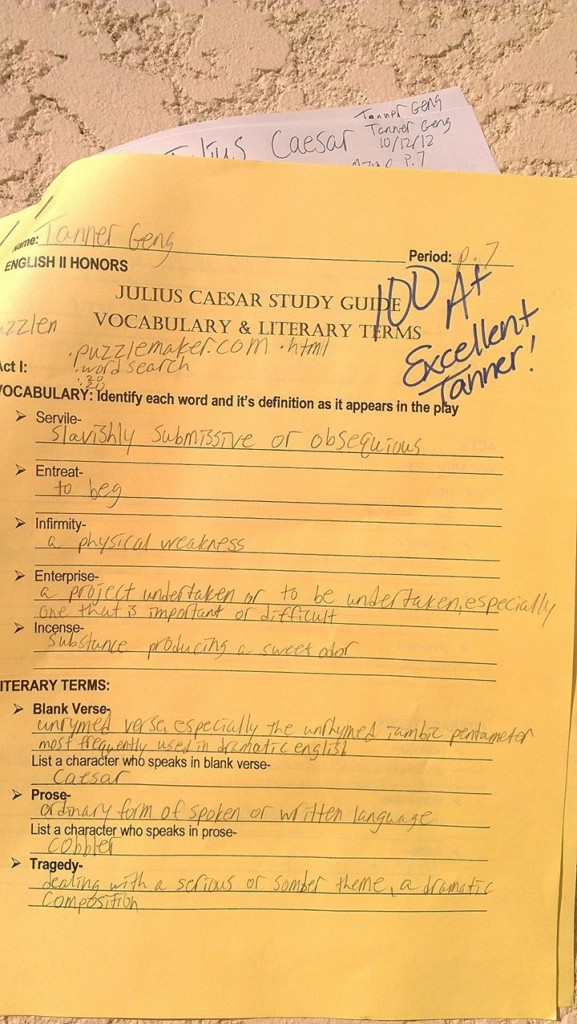
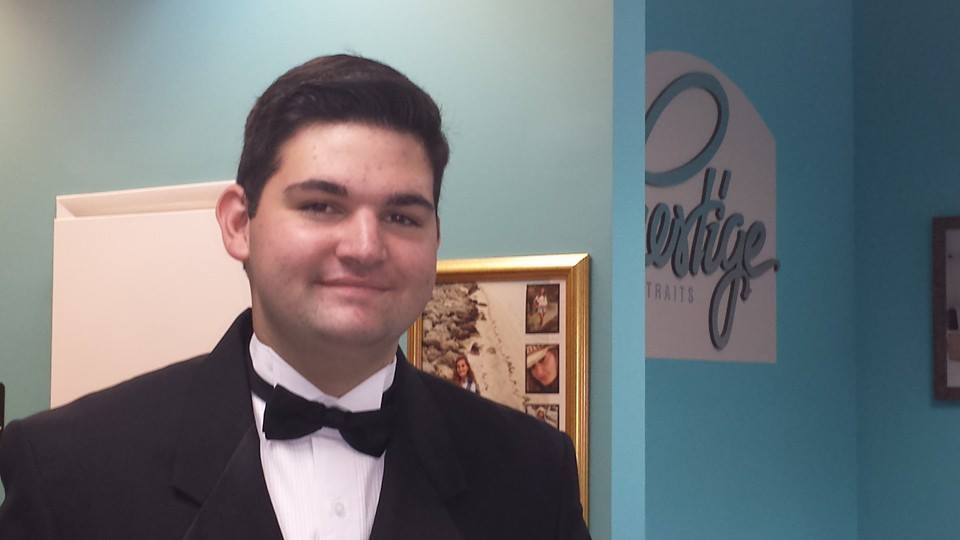
Tanner getting his high school year book photo taken
2019 Update
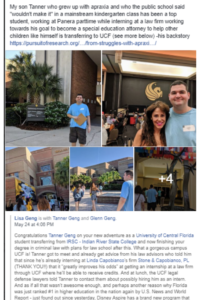
At 22 years old Tanner is in college still getting mostly As and a few Bs as he’s working on getting a BA in criminal justice and was just accepted into UCF. Tanner’s goal is still to attend law school to be a special education attorney. Even though he’s a full-time student he works around 22 hours a week part-time at Panera Bread to help pay for his school and car loans. Working at Panera, he’s working on his public speaking. He takes orders and deals with the public just as he did at his last part-time job at Toys R Us where he worked in the gaming section helping the public there.
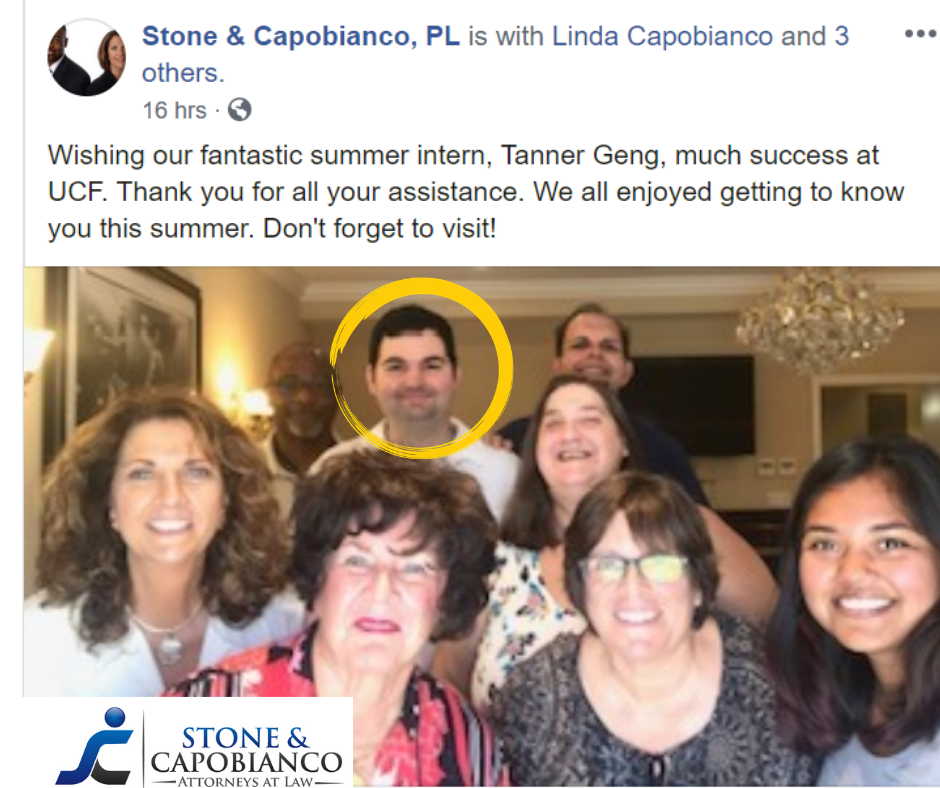
As he will be graduating soon he looked for an internship at a law firm. He called a local law firm and spoke to the one partner on the phone, and scheduled a meeting with both partners at the firm. The one partner got caught up in court but he met with the other partner. Just so happens the one partner he met with goes to the same gym as me and I was told that she was extremely impressed with Tanner’s “professionalism” (exact word) That he showed up right on time, looked her right in the eyes as they spoke, and that they had a long conversation about the legal system and his goals. He will be working at the firm over the summer and involved in every aspect of working as an attorney so he can get a feel of what it’s like to be an attorney. She also told me her partner was very upset he was held up in court and didn’t get to meet with Tanner. The best news is that I was told that there was no indication of a speech impairment while speaking to Tanner during the long conversation, and again said how impressed she was at how he presented himself, that he was so professional. So proud of Tanner as both attornies are excited about him starting his internship before he goes on to UCF. He really is kicking apraxia in the booty!
After Tanner interned summer 2019 at the law firm Stone & Capobianco assisting with everything from documents and depositions to jury selection, this is what the firm posted on their Facebook page
Tanner update shared at our Cherab Foundation online support group
A Note About Oral and Verbal Apraxia
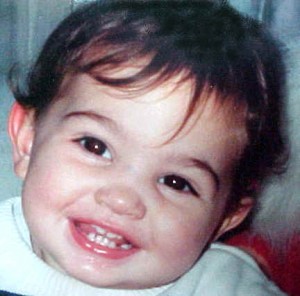
Tanner was diagnosed with both oral as well as verbal apraxia. While verbal apraxia is a lot more common than people today appreciate, oral apraxia is a diagnosis given much less frequently. Many people don’t know what Verbal Apraxia is, and even less know what Oral Apraxia is. Not all children with verbal apraxia will have oral apraxia, but it’s pretty much a given that all children with oral apraxia will have verbal apraxia. Before Tanner learned how to smile he didn’t even try much and most times just had a blank look on his face as you’ll see on the photo on the left. We called him the “serious baby” at this point not knowing he had classic signs of oral apraxia. On the right is a photo of Tanner smiling. Like others with oral apraxia you’ll see, he was able to smile once in awhile, just not often, and not on command.
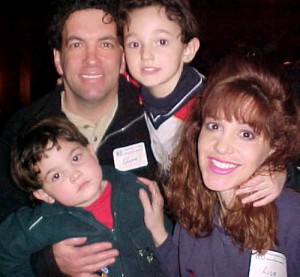
Below is me with my sons Tanner on the left, and his brother Dakota on the right on their first day of school. We were all so excited, and you can see the school bus in the background. Tanner had to learn how to smile due to his oral apraxia. When Tanner was learning to smile he would smile and close his eyes. We’d then say “Tanner open your eyes” and he’d open his eyes and open his mouth. Then we’d say “Smile again” and again he’d smile and scrunch his face like in this photo again which was his classic smile for awhile.

Tanner’s background is here which is a letter I wrote to parents years ago to raise awareness about oral and verbal apraxia. But most don’t know what oral apraxia is or how it can affect a child and his family. The impact it can have in school when that “blank look” is taken by the teacher as not understanding. Tanner’s oral apraxia affected him for most of his life up till recently. At age 11 after years of therapy his one therapist Dr. Renai Jonas even tried hooking electrodes to his face to stimulate the nerves with little help. Tanner responded to nutrition somehow which is remarkable after the years of therapy. We are so thankful!
Signs of Oral Motor Dysfunction
|
Possible Oral Apraxia or Oral Motor Warning Signs from the Cherab Foundation There are two types of oral motor problems. Oral Apraxia is a disorder where the child, who typically is a “late talker” is unable to coordinate and/or initiate movement of their jaw, lips and tongue (articulators) on command. An Oral Motor Disorder, which could be a different oral motor problem than apraxia (could be from weakness/dysarthria for example) is the second type, in which the child is unable to coordinate and/or initiate movement of normal eating movements (vegetative activities.) Here are some possible warning signs of the two types of oral motor problems, written by Lisa Geng, the parent of two children who were diagnosed by a neurologist (Trever. DeSouza MD) and a neurodevelopmental pediatrician (Marilyn Agin MD) with two different types of oral motor problems, with help from Cherab’s advisor, Sara R. Johnson, CCC/SLP. Can your child do the following regularly or on command:
If your child cannot do all or some of the above, this may be a sign of Oral Apraxia, which is worth looking into with medical and speech professionals. Or does your child…
If your child does all or some of the above, this may be a sign of Oral Motor problems, which is worth exploring with medical and speech professionals. If you are seeing any of the above signs, seek out the services of a Speech Language Therapist for an evaluation of these skills. This can be done through your State’s Early Intervention Programs, a free federally funded program for qualified children from birth to three years of age or through your school district’s preschool disabled program, a free program for qualified children between the ages of three to 6 years. You can also contact the American Speech Language-Hearing Association in Rockville, Maryland for a list of certified clinicians in your area. It is very important to have an ACCURATE assessment completed by a skilled clinician. You may also want an evaluation from a developmental pediatrician, or pediatric neurologist to look for signs of low tone (hypotonia). |
I am so inspired by Tanners story. My son, Ryan, has apraxia, diagnosed at 3 and it has been such a struggle for him. Even with early intervention and private speech. Special education at our school has been an ongoing fight for proper assistance on helping him succeed academically. He is now approaching 9 and we have to prove that he needs more than speech on his iep. With my ongoing research to be the best advocate for him,mi came across your article, such a positive reinforcement to see Tanner thrive and reach his goals. I was hoping you could give me more detail on how you started with the supplements. Any side effects? Also, Ryan is a super picky eater, and will be able to know a difference in taste, especially with the fish oils. He does not swallow pills yet, so it would need to be a liquid form. I hope to hear back from you and how Tanner is doing currently. Gives me so much hope for a positive future. Thank you,,,, Lisa Levine